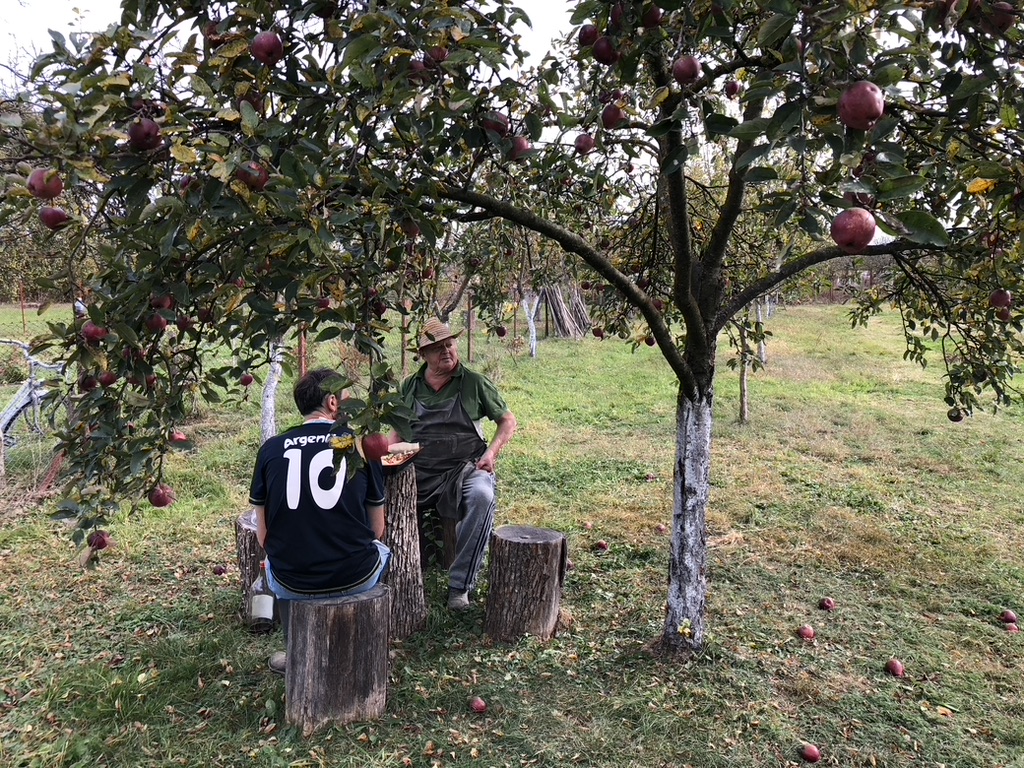
It’s still warm in October. The skies are fairly clear and the sun is generous. We sit in the orchard on some logs that have been erected to stand and serve as chairs. Above us, the branches are overstretched under the weight of apple fruits. They are bending down, almost begging for those fruits to be harvested. But we’re in no rush, Maximilian will say. They have to fall down by themselves when they are ready. That means that whenever they will achieve the maximum amount of sugars, they will lose their grip on the tree and let themselves on the will of gravity. It is a quiet afternoon and I try to make him reveal the secrets of the moon shining.
Earlier we took apples gathered by Gina, and brought over in a wheelbarrow and crushed them using an ancient device, made of wood and iron parts. Two grooved cylinders will rotate one towards the other, and by touching each other in a common section, would catch the apple and force it through the grooves, crushing it into pieces, juices dripping down. The pieces falling down in the barrel will then mix with the juice and form a paste. Not a good-looking one, but full of sweetness. You can tell by the smell and the billion of little flies buzzing.
That is the start of fermentation, sugars turning slowly into alcohol under the invisible to us action of natural yeasts. The paste will sit in the barrels for a few months until they will be readily taken to a small distillery.
Harvesting takes weeks and months, there is no rush, every apple has to ripen naturally then fall on the grass below the tree, some of them decaying. Some insects and birds will bite on them, leaving small or larger hollows, but the plentitude of apples is high larger than their appetites.
There is no concern about sanitation. In the fermentation process, all potential harmful bacteria will perish under alcohol consumption. The switch from eating sugars to soaking into alcohol rich paste will be lethal to them.
One afternoon, somebody will come with a tractor and a trailer. The barrels will be loaded alongside with 3 feet cut pieces of firewood. The last one would have been well seasoned.
The distillery is a small barracks. Its wooden walls barely sustain a roof and inside there is the still, made of copper. The fire gets going and the long, thick logs are added gradually to maintain a steady flame. The apple mixture is added in the still, mixed up and the boiling soon starts. It will be a slow process then going late into the night. Usually it gets till in the morning. The workers are frantically mixing the paste and adding wood into the fire. Meanwhile, the moonshine owners are helping. Pork fat is fried over the fire, and its fat pours onto slices of bread, with crumbled cheese and diced onion spread on top. It’s hard work but also a feast. The chief distiller is not charging money for distillation, despite being taxed heavily by the state for daring to run such a business. Instead, out of every gallon of moonshine produced, he will keep for himself a tenth. It is an ancestral way of making business, impossible to explain in contemporary terms.
When the first drops of the distilled product will come through a pipe, the workers will signal to everybody that the boiling is about to do its job. They will save the first half of gallon into a separate container, as that is poisonous because of the remnants collected in the still. Then, a clear liquid will start coming, and everybody will happily taste it to enjoy the harvest flavor. It is an essential part to put in the mixture only the fruits of your own trees, is part of the alchemy involved. The chief distiller will declare its quality aloud, and everybody’s moods will be uplifted by the alcohol. But this is not the end of the process. The first product is not the final one, it is something not strong enough yet. Its content of alcohol is somewhere below 40% and that is not enough. This first batch is put back to boil. By now, everybody is a little more spirited, as the tasting had to be done by everybody present. More wood is added and the second boil starts while the workers are warming by the fire. Food is served, slices of bread over which sliced onion and scramble of cheese was spread. Slabs of pork fat are pinched with long sticks and then they are slowly fried over the fire, the same one that warms the moonshine. This dinner will be ready and prepared just when the second distilled liquid is coming out. The chief distiller, pour some of it into a glass. He smells it and then throws it over the overheated still. When the moonshine hits the hot surface, it ignites instantly. People are cheering and applauding. If you’d need a match or a lighter to ignite it, that would mean failure because it will show low alcohol content. The first one to taste the newly released moonshine is the beneficiary, and he will have the last word of approval. At that point, the chief distiller will measure the quantity resulted, he will keep his part and he will leave for home. The workers and beneficiary will stay longer to eat the pork and do more tasting. Each person will have their own opinion on the results. By dawn, the party will leave, meaning the tasting has concluded. All the stories told will remain in the shack and they will try to walk to their homes, struggling to maintain a straight line.
This is a tradition in this part of Transylvania that lasted for centuries. This moonshine is called palinka, and it’s a very strong liquor. We’re talking about 52 to 54% alcohol. A regular bourbon is 45%.
Sitting here in the orchard with Maximilian, I wonder at the ripening fruits hanging down from the trees. We’re having a conversation, but it’s more like a conversation about the ways of life in the countryside. The richness of the harvesting season gives the impression that the nature is so generous. Indeed, it is, but none of this will be possible without hard work and a very attentive and knowledgeable care. The Man in front of me is a perfect exemplification of a perfect master. He feels the means of nature and knows instinctively when to act and when to rest and reflect. He can see the eventual results from the inception of things because he accumulated experience.
The making of palinka is a noble tradition, and its taste is fantastic. It touches your mouth with fruity flavors, then goes down, your guts burning in its way. It’s like a fire that warms you up from the inside out.
Modern science has shown us that alcohol consumption is dangerous for health, and excesses are disastrous, but here we are seeing the unity between the nature and the skills of man. This is sorcery at its finest, alchemy at its best. It is the beautiful result of one’s handwork.
Maximilian knows everything about this, but he doesn’t think this is a big deal. For the practical man in him, this is just a normal way of doing things.
 words-of-mine
… toamna lu 2020 cred am participat la ceva de genul☝️ la hinchiris… ce a fost în plus față de descrierea ta or fost crómpii pusă pă sau în jar!!!! să’ț baț pruncii!!! așe’i cum grăiești… pălinca batii dă dipartii uischiul!!! ce și mai spui; nialcoș li mai zàci 👋👋👋
LikeLike