
It’s late fall in Transylvania, warm weather and clear skies. A little unusual for this time of the year, an alarming sign or just a caprice of the seasons. Fruiting trees are still bearing fruits, some grapes are still ripening on the vines. More so, a peaceful golden glamor of the fields and the rusty colors of the woods give an air of unusual stability when the world around is on the brim of war.
My father-in-law delayed some of his seasonal farm chores to show us how things are made, a unique lesson, an invaluable experience, or just a gift, the sweetest of all.
This man is an open book. Eight decades of experience is more than most of us can apprehend. He saved another precious present. As the events of this year unfolded in an unexpected and saddening way, we thought we missed the last year’s wine. But we did not. By some mysterious means, a last jug survived the journey and stayed untouched by the bad ferments.
You should have seen his satisfaction when, after tasting it himself, he knew the wine preserved its goodness perfectly. Now, you probably think that a wine should be only better as it ages, but this is not the regular wine we all know and heard about. This is a very special type of wine, one for which absolutely no preservatives are used. It is home made for years, from grapes that grow and ripe on well-tended vines, stretching over the house yard and the adjoining fences. It should be a striking example of the exact opposite of how the grapes should grow. There is no fertilizer or pesticides. It is secret alchemy and the love between dirt and sun that nourishes them, under the attentive care of a kind master. The Master Winemaker knows just the right time when to intervene to support the growth, and he spends no time to “cultivate” himself about how to make a better wine, because this is not a product that needs to be bettered.
We went in the special room that is reserved to store the wine, a part of the building that meets just the right characteristics to maintain a perfect environment without the need of any artifice, the design itself, the materials used to built it, probably more than a century ago is all it needs. We brought specially repurposed bottles, and the actual act transferring the wine from its big glass jug in which it spent the year to “boil” as the Master calls the fermentation process, began under the best auspices. He reserved the right moment of the act following an ancestral calendar of which existence and use he only has knowledge. When that time arrived, he made the call, and we approached the recipient with reverence and intense emotion. He pulled a special hose which was previously affixed on a stick, and he explained to me how the end of the hose that will be sank into the wine is not to get to the bottom of the jug, because there is sediment we don’t want to pump out. That depth was not measured, and he showed me how deep should be just with a simple gesture. When the stick touched the bottom, he primed the hose with blowing a breath into it, which I assume is part of the secret alchemy, and the precious liquid came out bringing a pleasant flavor that spread quickly in the room, and dropped in the bottle, through and old, chipped and little rusty funnel. The sound made by the wine splashing in the bottle raised notes of joyous song. The flow was interrupted with a press of the finger on the end of the hose and he lifted the bottle to place it in between his eyes and the glimpse of light that made its way in the obscure room through the open door. I could see the satisfaction of the master being proud of his own creation. The wine was red and clear, just as he expected to be. He tasted it and concluded the wine was perfect. What an act of simple celebration, the supreme accomplishment of year long hard but passionate work! During those moments, as we topped off more and more bottles, enjoying the perfumes of the previous year harvest, I saw what life is and how smitten we are to think that you need tons of philosophy books and dozens of theories and theoreticians, plus tens of experiences to reach a sublime level of perfect harmony with time and nature. And, just to clarify, I had had none of that wine yet. That would be a more superior experience.
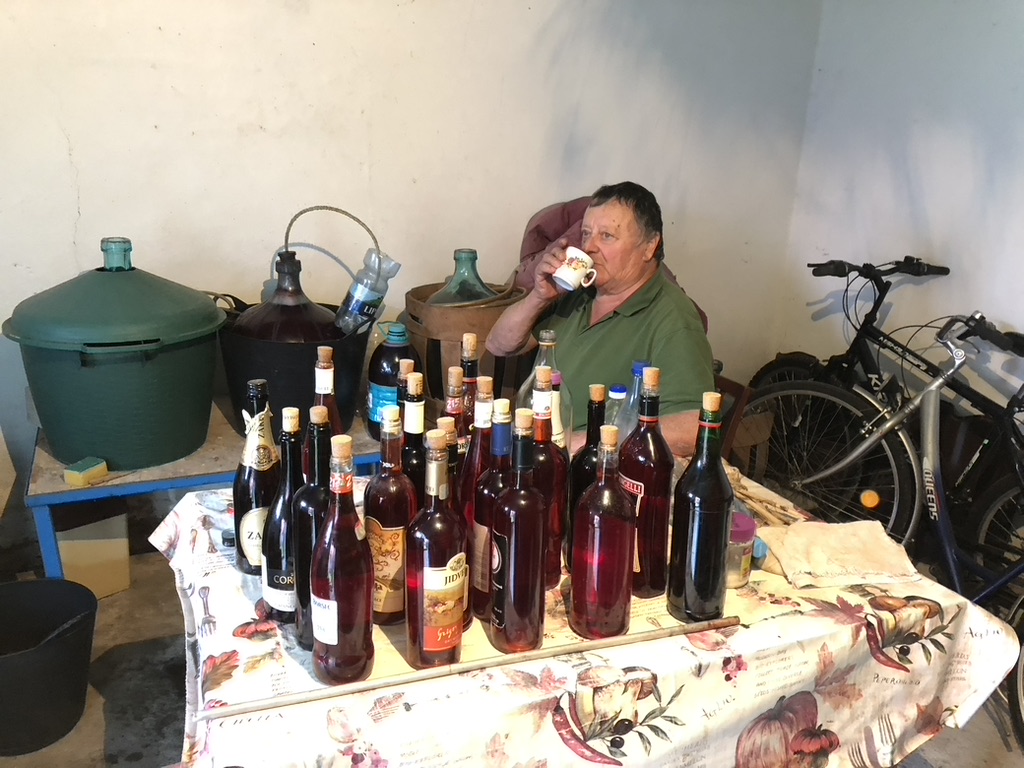
When the last drops of wine fell into the last bottle, we carefully arranged them on a table, caped them and admired once again the color and clearness. The sun was only touching the table just to allow us to see the color in the semi-obscure room. The Master carefully chose the recipients we will take with us down in the town. What was left, we put on a shelf, well hidden from the light, and we covered them with an old rag for more protection. One bottle that couldn’t be filled all the way up remained on the table for the tasting. We poured its content in an old cup from which we blew away a few dead flies and some remaining of spider web. The Master had the first sip and then he offered me the cup. I felt the liquid in my mouth and enjoyed its perfect temperature. Then all those flavors took over my senses, the smell and taste of a late fall, with various fruits ripening under the sun, a romantic and sensual flow of moments. The Master was smiling widely. He could see the results of his work in my eyes, and no words were needed.

At night, nested in the cozy gazebo, we forgot about the stars and lonely nights, swallowing that magic potion sip by sip and talked about the past, about the future. The Master Winemaker’s name is Maximilian. In Latin it means “The Greatest”! By some unknown means, eighty years ago, his parents sensed the fate of this special man very well and named him accordingly. Master Maximilian was born in the village where that magic wine is it now produced, and grew up like any other kid at that time, working the fields and going to school. Not too much time was left for playing. Those were hard times, but he never complained about them. He went to school and became a Master Carpenter, an expert in transforming the wood into furniture, an artist of sorts. Maximilian founded a family and became the father of two children, a boy and a girl. She became later, my most loved one and we decided to live together forever, and that’s how I got to know The Master. Well, he actually acted as an intermediate to bring us together, but that is a totally different story. Now, with the crystal clear glasses in front of us, we kept refilling and sipping on that goodness, and chatted about everything. I am asking about the process of making the wine, hoping to discover some complicated secrets, but The Master is straightforward: “All you need is to squeeze the grapes into a barrel, wait a day for the liquid to separate and just take it out and put it into the jug where the juice will ferment. Don’t squeeze the resulting paste a second time! And when you add the grapes, don’t just throw them in there. Separate all the moldy and bad grapes by hand.” This way, every grape is actually touched by his fingers and selected to go further or not. (I need to mention that this second squeeze is a common procedure in the general wine-making process, more juice containing more tannins is resulting). That is good to be mixed with the crushed apples that will ferment to be distilled into another great drink about which we will discuss in a future story. He sinks a hose into the grape juice, running through a little hole in the jug’s cap and the other end is put into a jar with water. That way, the carbon dioxide that the millions of bacteria transforming sugars into alcohol are breathing out is released, but the air can NOT go in. The eventual flux of oxygen will encourage the bacteria to process the sugar further more, alternating the juice into an unpleasant tasting and undrinkable solution. This technique only allows the minuscule guys to process just the perfect quantity of sugars into alcohol, making the wine perfectly balanced, sweet flavored but not necessarily sweet, a little strong to warm your mood but not too strong to get you drunk, and just as little bubbly as to give it a refreshing texture. Isn’t that magic!!!

The bottle gets emptier with the passing of time, but the stories are just about to begin. I am afraid we will have to bring another one from the cellar.
In a time when Romanians were living a very dull life under the communist regime, in a country in which there was no color, no open doors to the outside world and, in general, no opportunities for individuals but whatever was given by the state, Maximilian became the hero of an adventure that can hardly be imagined even in the “everything is possible” world we live today. As his skills in the woodwork perfected, he became a renown specialist and was sent by the authorities in Mongolia, thousands of miles away from home, to help establish a furniture factory in Ulan Bator. Maximilian mission was to show the Mongolians how to make furniture, and how to use the machinery. What followed was a chain of events and adventures that still fascinates today. In a world where opportunities were extremely rare, one had to know exactly when to act, a skill that is not common, but he knew exactly when to make his moves, instinctually and efficiently. This is a story in which Maximilian traveled between Mongolia and China multiple times, establishing a business of trading merchandise from one country to another. He moved with precision and turned nothing into profit. He met people of different nations, and learned how to communicate without learning their language, built connections that led from regular people to diplomats and officials quartered in Beijing and Ulan Bator. This is a story of proportions that needs its own novel. In a few months the business grew fantastically and the return home is most likely worth another novel. Maximilian, accompanied by his wife Aurelia, returned from Ulan Bator to Romania, traveling by train, crossing the entire Asian continent from Novosibirsk, through Moscow, and finally arriving in Bucharest. They loaded, according to their memory at least fifteen big luggage in the train, all filed up with variable goods, from expensive and rare furs to fine clothing and exquisite jewelry, and traveled that way through the entire Soviet Union, crossing the unmerciful Siberia without being bothered by authorities. This trip took two weeks, and they made it into Romania, fouling the strict custom officers of the time, backed up by the high connections build back there in the faraway capitals.
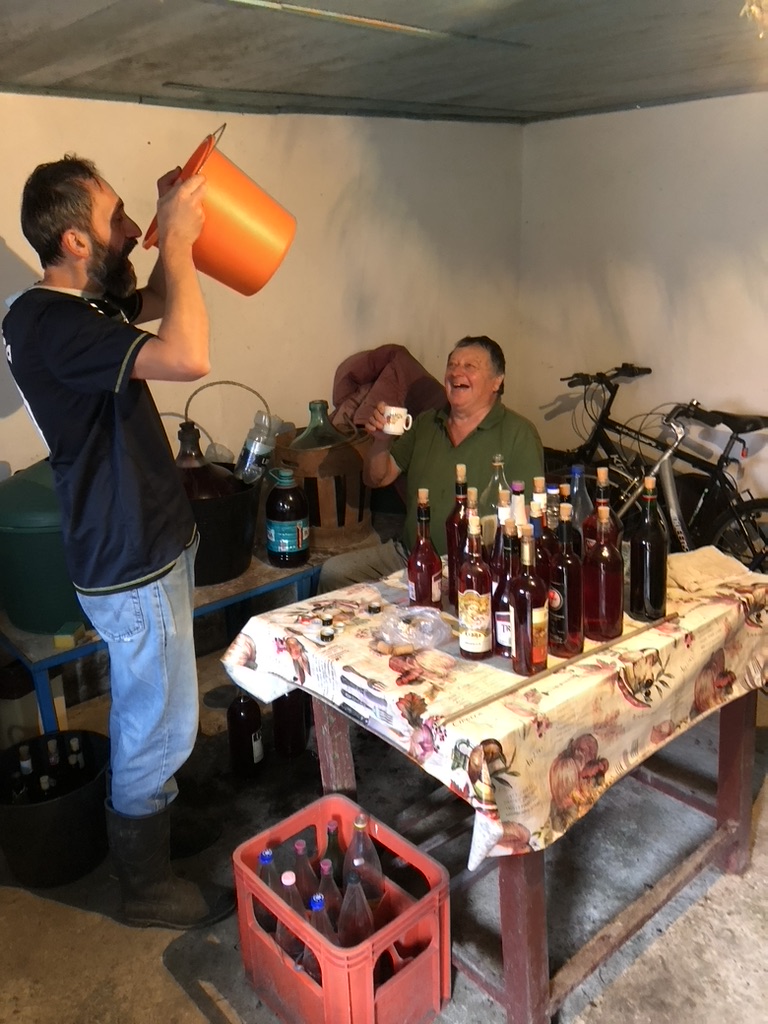
Here and now, drinking this wine, I am amazed at the simplicity of this great man that faced the cruel times with a smile on his face, and I wonder what exactly takes a child to grow into a man like him? Is the natural born skills he inherited or just the harsh environment that molded him into the man I admire so much? We are chatting at this late hour, and I am thinking where did we, the generations of today, lose our connection with the common sense, where did we waste our chance to get that practical experience that seems to be forever lost? It seems to me that this is the greatest quality of The Master Winemaker, a common sense and a sense of humor that have no equal. Maximilian is an example of a positivism that is definitely unique in this world. The combination of his emotional intelligence and the immense practical experience creates this great impression and admiration of him. And there is enough wine in the cellar to go further into the night with his stories.
 words-of-mine